

Rules of Play
The Sembli card game
Ruleset
2 players, age 7-99, 15' play time
Story & goal of the game
In every society, people hold different visions of how we should live and shape our future. Democracy is about bringing these perspectives into conversation — and finding ways to make better collective decisions.
Sembli translates this democratic challenge into a card game. Players build citizens’ assemblies by combining different voices, institutions and societal visions. The four suits represent four visions for society: Technology ◆, Nature ♣, Tradition ♠ and Solidarity ♥.
Kings and Queens represent people or institutions with formal power and influence. Number cards represent citizens and everyday perspectives. Jacks, Aces and Jokers represent organisations, experts, institutions and bridge-builders who connect citizens’ voices with decision-making.
Your goal is to create strong card combinations that represent convincing arguments and broad coalitions of ideas.
Goal of the game: Build the strongest citizens’ assemblies and win influence by forming convincing card combinations.
1. Setup
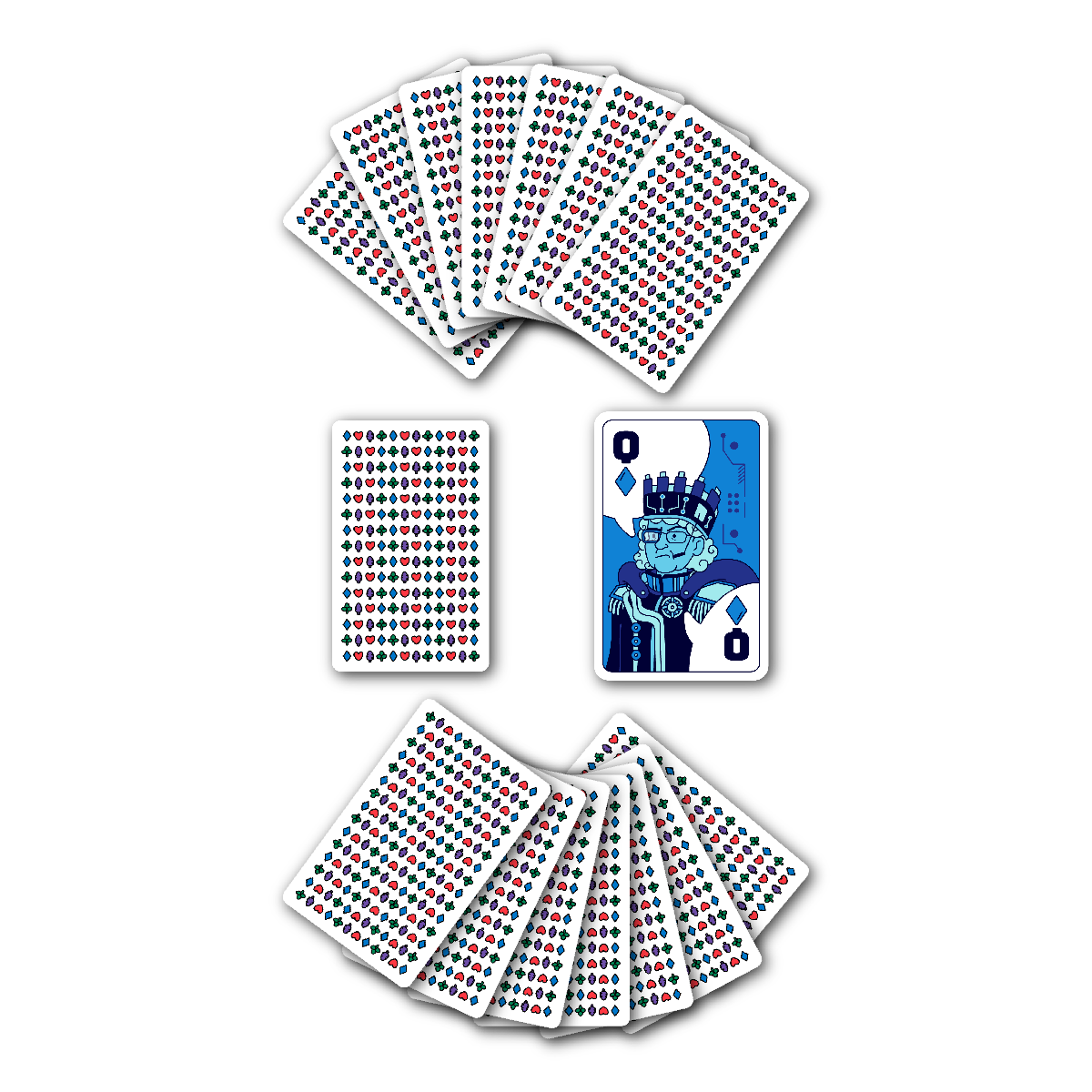
a) Power Deck: Shuffle the Kings and Queens (those in power) separately. Place them face down. Reveal the top Power Card in the center of the table to show who needs to be concinced with a new idea.
b) Starting Hand: Shuffle the remaining Civil Cards. Deal 7 cards to each player to represent the diverse voices of citizens.
c) Mulligan: Before the first turn, you may discard any number of cards once and draw the same amount of replacement cards to realign your starting ideas.
2. How to Play
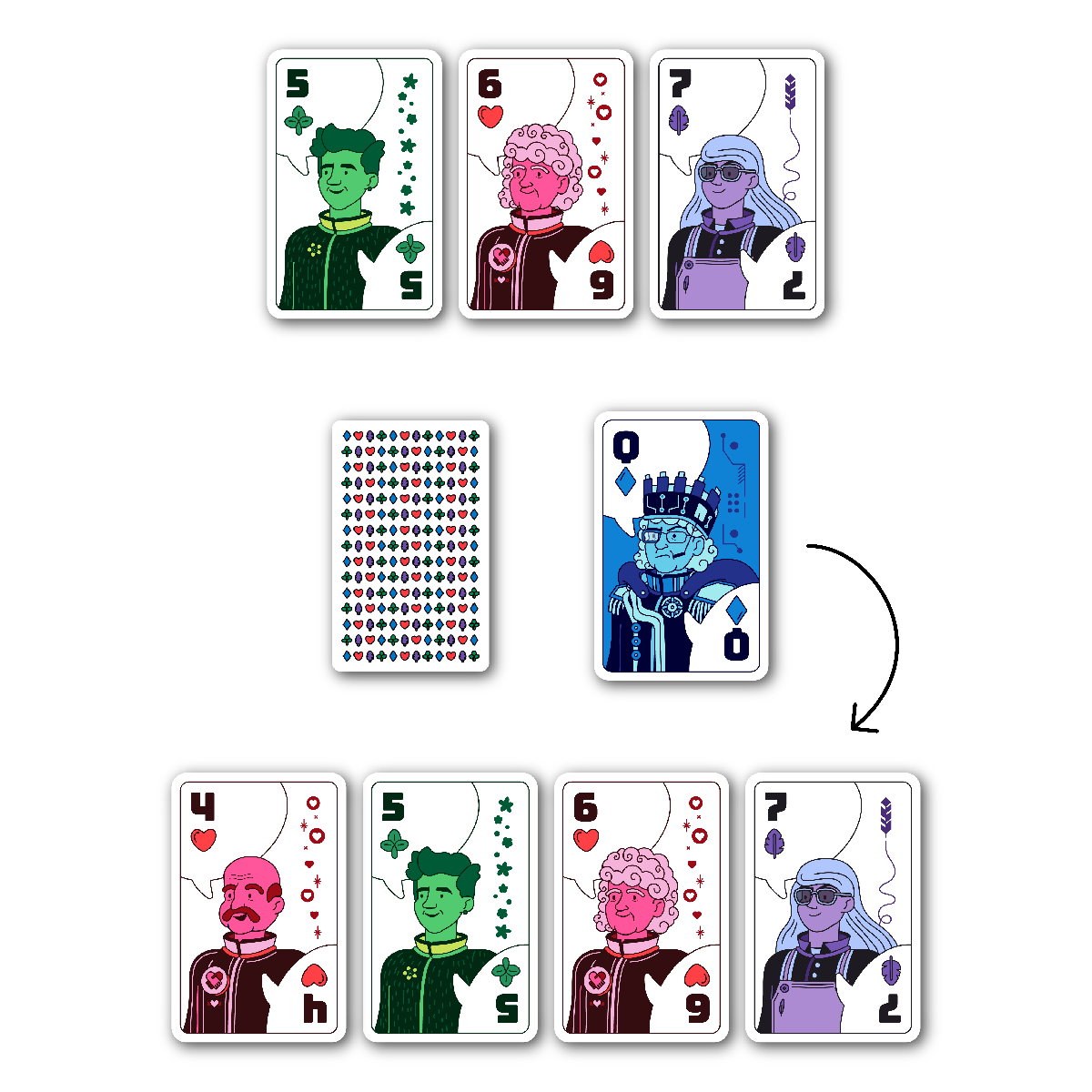
a) Presenting Arguments: The youngest player starts. Players take turns playing one argument (a valid combination of 3 or 4 cards) face up. An argument can only convince the powerful if the card combination contains the suit of the current Power Card on the table. Whoever has the stronger argument convinces the Power Card. There are three groups of arguments (A, B and C) as visible below. The played cards are then placed on a discard pile.
b) Next Arguments: Both players draw back up to 7 cards to bring in new voices from society. Reveal the next Power Card. The other player now leads the next round by playing an argument (card combination).
c) Passing: If you cannot or choose not to present a valid argument, discard one card and draw a new one.
d) End of game: The game continues until all Power Cards have been convinced with an argument. Each captured Power Card is worth 1 point.
If the draw deck runs out of cards, shuffle the discard pile and the remaining cards from the draw deck and place them face down to form a new Draw Deck.
3. Argument – card combinations

a) Types of Arguments: In Sembli, each card combination represents an argument. There are three types of arguments:
A) Arguments made only by civilians (number cards) with no structural power.
B) Arguments made by civilians, together with institutions, organizations, and experts with some power (Jacks, Aces and Jokers).
C) Arguments made only by civilians with broad civil consensus.
b) Argument Strengths: The strength of an argument is determined as follows.
1. C is stronger than B, and B is stronger than A.
2. Within the same argument type (A, B, C), lower rows are stronger. Four of a kind is stronger than three of a kind. Two pairs are stronger than a large straight of four cards, and a large straight is stronger than a small straight of three cards. In other words: row 5 is stronger than row 4, row 4 is stronger than row 3, and so on.
c) Argument Tie: If two arguments are tied, the stronger argument is the one that
1. contains more different suits.
2. is closer to power: Ace is closest to King, and Jack is closest to Queen.
d) Joker: A Joker may stand for any value except King or Queen, and may appear only once in a card combination.